
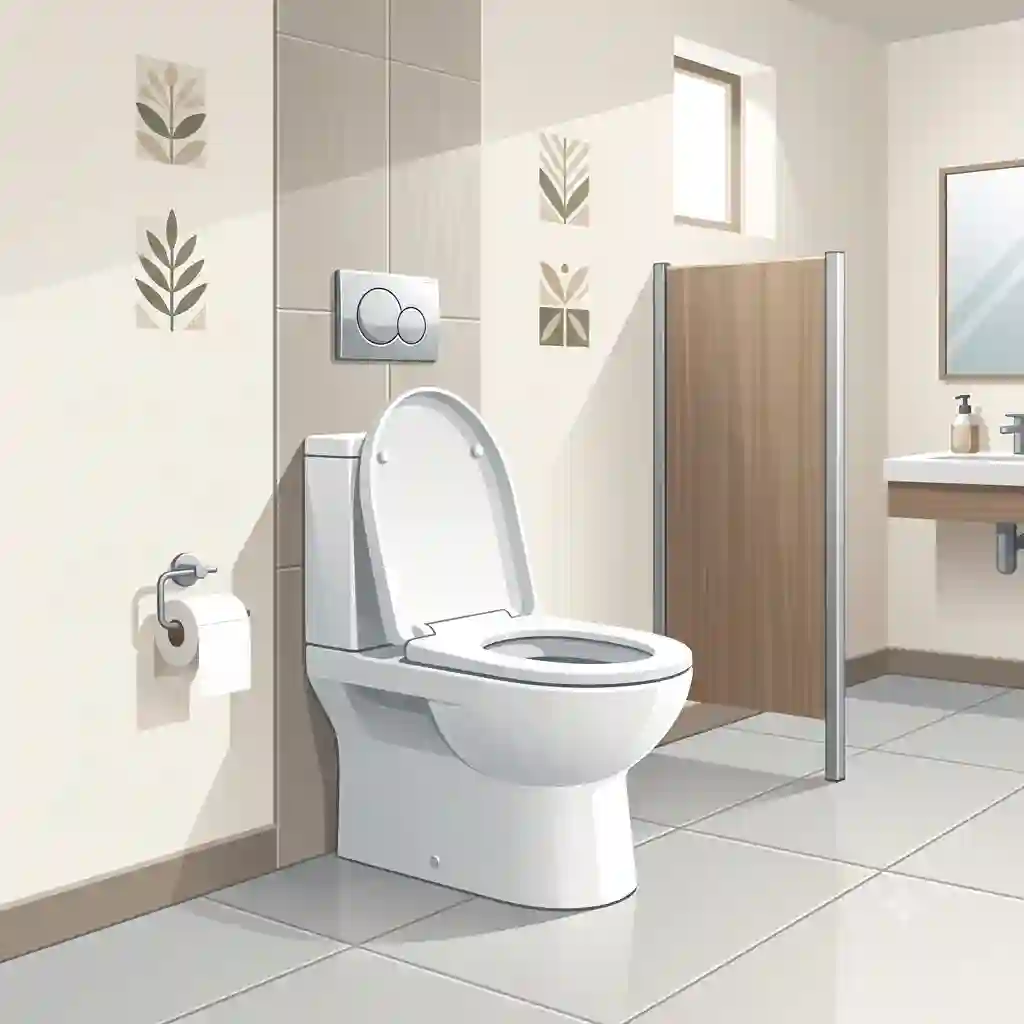
If you had told me a decade ago that residential homeowners would be calling my consulting firm asking for advice on installing a standing toilet, I would have laughed. Historically confined to stadium restrooms and corporate office buildings, these fixtures—traditionally known as urinals—have undergone a massive design renaissance. Today, as water conservation mandates tighten across the US and modern bathroom architecture embraces functional zoning, the residential standing toilet has become a highly requested upgrade for master suites, garage workshops, and finished basements.
What is a standing toilet?
A standing toilet is a specialized plumbing fixture designed exclusively for urination from a standing position. Modern iterations feature highly contoured, splash-resistant basins, eco-friendly flushing mechanisms (or waterless technology), and sleek aesthetics tailored for residential use. They dramatically reduce water consumption and eliminate the hygiene concerns associated with using traditional seated commodes for standing urination.
In my years of hands-on plumbing and bathroom design, I’ve installed hundreds of these units. What most homeowners don’t realize is that translating commercial plumbing to a residential stud wall requires specific engineering foresight. You aren’t just buying a ceramic bowl; you are investing in a waste management system that interacts differently with your home’s existing venting and P-traps. In this guide, we will bypass the marketing fluff and look at how these fixtures actually perform after months of daily use, breaking down everything from trapway hydrodynamics to the hidden costs of waterless cartridges.
Quick Comparison: Top Standing Toilet Models
To help you navigate the cluttered market, here is a breakdown of the top performers I currently recommend for residential and light-commercial installations.
| Model | Flush System | Best Use Case | Water Usage | Price Range |
| Kohler Steward | Waterless | Luxury Home / Eco-Build | 0.0 GPF | Premium (Over $600) |
| Fine Fixtures HEU11 | Manual Flush | Budget Retrofits | 1.0 GPF | Entry (Under $150) |
| TOTO Commercial | Sensor Flush | Modern Master Baths | 0.125 GPF | Mid-Range ($300-$500) |
| Sloan Washbrook | Sensor Flush | High-Traffic Garages | 0.125 GPF | Mid-Range ($300-$500) |
| American Standard | Manual Valve | Classic Home Designs | 1.0 GPF | Mid-Range ($200-$400) |
Looking at the comparison above, the waterless Kohler Steward delivers the highest long-term ROI in drought-prone states, but requires a strict maintenance schedule that budget buyers often overlook. If you want a traditional water-cleared system without the premium price tag, the Fine Fixtures model is an excellent entry point, though you sacrifice the ultra-low 0.125 GPF efficiency found in the TOTO and Sloan sensor models.
💬 Just one click — help others make better buying decisions too! 😊
[addtoany]
Top 5 Standing Toilets on the Market: Expert Field Analysis
When evaluating these fixtures, I don’t just look at the porcelain. I evaluate the rough-in requirements, the availability of replacement parts, and the reality of keeping them clean. Here are the models that survive the real world.
1. Kohler K-4904-ET Steward
The Kohler Steward represents the pinnacle of modern waterless technology. Its sleek, teardrop design is undeniably striking, but the real engineering marvel is the cartridge system hidden in the trapway. Instead of water, it uses a specialized liquid sealant that is lighter than urine. As waste enters, it passes through the sealant, which then floats back to the top, creating an airtight barrier against sewer gases. This means zero water usage and no complex flush valves to maintain. At around the premium $600-$800 range, it’s an upfront investment that pays dividends in water-restricted regions.
In my field tests, this is the definitive choice for eco-conscious luxury builds and off-grid setups. However, it requires a specific homeowner. If you are someone who expects a “set it and forget it” fixture, a waterless standing toilet is a bad fit. The sealant needs to be replenished, and the cartridge must be swapped roughly every 7,000 uses. If you pour a bucket of soapy water down it to “clean” it, you will destroy the chemical barrier and invite terrible odors into your home.
Most reviewers claim this fixture smells, but in practice, I found user error to be the real issue. When maintained exactly to spec, it is entirely odorless. The community feedback heavily praises its architectural aesthetic, noting that it looks more like a modern art piece than a bathroom fixture. It’s perfect for the meticulous homeowner who wants ultimate water efficiency.
✅ Pros: Absolute zero water usage; visually stunning; no moving parts to break.
❌ Cons: Requires proprietary cartridges; cannot be cleaned with standard chemical bleach.
2. Fine Fixtures HEU11WH
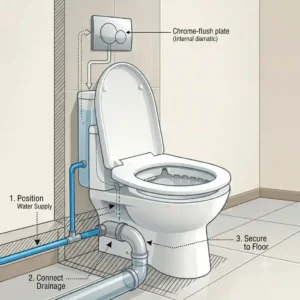
For those testing the waters of adding a standing toilet to their home without breaking the bank, this Fine Fixtures model is the ultimate workhorse. Usually falling in the entry-level sub-$150 range, this is a standard wall-hung, wash-down unit that operates exactly like the classic fixtures you are used to. It features a top spud (the connection point for the flush valve), meaning the plumbing will be exposed rather than hidden behind the wall.
I frequently recommend this unit for garage conversions, basement workshops, or older homes undergoing a retrofit. Because it doesn’t require complex in-wall sensor carriers, the installation is straightforward for a seasoned DIYer or significantly cheaper when hiring a plumber. What surprised me most during use was the efficiency of the bowl wash. Despite the budget price, the rim design distributes water evenly, preventing the dreaded “dry spots” that plague cheaper ceramics.
Customer feedback consistently highlights its unbeatable value. The major complaint is that it does not come with the flushometer valve—you have to buy that separately. This is standard in the plumbing industry, but it catches casual buyers off guard. For a low-cost, high-reliability setup, this traditional wash-down model is hard to beat.
✅ Pros: Highly affordable; straightforward installation; durable vitrified china.
❌ Cons: Flush valve sold separately; exposed plumbing isn’t ideal for luxury aesthetics.
3. TOTO UT104E#01 Commercial Urinal
TOTO is practically royalty in the bathroom space, and this high-efficiency model demonstrates why. Rated at a microscopic 0.125 Gallons Per Flush (GPF), it clears waste with a fraction of the water used by a standard toilet. The magic here is TOTO’s proprietary CeFiONtect glaze—an extraordinarily smooth ceramic finish that prevents microscopic particulate matter from adhering to the bowl. You can usually find this unit in the mid-$300s, making it a reasonable mid-range investment.
If you are outfitting a high-end master suite and want a standing toilet that stays immaculately clean, this is my top recommendation. The ultra-low flush volume is fantastic, but it demands excellent water pressure in your home to achieve the necessary velocity. In older homes with corroded galvanized pipes, the 0.125 GPF might not provide enough force to clear the trapway effectively.
Actual users rave about the compact footprint, noting it fits perfectly into tight water closet layouts without crowding the primary commode. However, DIYers frequently struggle with the mounting bracket. Unlike standard French cleats, TOTO uses a highly specific carrier system that requires precise blocking behind the drywall. If you are prepared for a slightly complex install, the long-term hygiene benefits of the CeFiONtect glaze are unmatched.
✅ Pros: CeFiONtect glaze repels stains; ultra-low water usage; sleek, compact profile.
❌ Cons: Demanding installation process; requires strong household water pressure.
4. Sloan WEUS-1000.1001-0.125 Washbrook
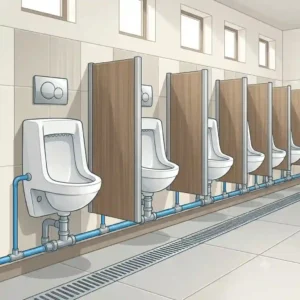
Sloan practically invented the modern commercial flushometer, and the Washbrook brings that bulletproof reliability into a slightly more refined package. Operating at 0.125 GPF, this system often comes bundled with a battery-powered sensor flush valve. Sitting in the $400-$500 range, it bridges the gap between commercial durability and premium residential functionality.
What the spec sheet won’t tell you is how aggressively this unit flushes. The Sloan diaphragm technology delivers a burst of water that creates a miniature hydro-cyclone inside the bowl. In my experience, this makes it the absolute best choice for a heavy-use environment like a multi-car garage or a frat-house style basement. You don’t have to worry about users forgetting to flush, and the battery life on the sensor typically lasts for over three years of average residential use.
Community consensus praises the “hands-free” sanitation aspect, which is a major selling point post-2020. The trade-off is the noise. The rapid-action diaphragm is loud—much louder than a gravity-fed toilet. If you install this in a master bathroom sharing a wall with a bedroom, a midnight flush will absolutely wake your partner.
✅ Pros: Hands-free sensor operation; commercial-grade durability; excellent bowl clearing.
❌ Cons: Very loud flush action; industrial aesthetic doesn’t fit all decors.
5. American Standard 6590.001.020 Washbrook
Not to be confused with the Sloan model of the same name, the American Standard Washbrook is a universally recognized classic. Operating natively at 1.0 GPF (though adaptable to 0.5 GPF with the right valve), this is a large, deep-sloping standing toilet that prioritizes splash reduction over ultra-modern aesthetics. You can generally secure this fixture in the $200-$300 range.
I consider this the ultimate “peace of mind” fixture. The extended sides and deep basin geometry significantly reduce floor splashing—a critical factor if you are installing this over porous stone or high-end tile. What most buyers overlook is the 2-inch trapway. Many modern eco-units use a smaller trap to increase water velocity, which makes them prone to scaling and blockages over time. The massive trap on the American Standard guarantees it will never clog under normal use.
Reviewers love its practicality, particularly in homes with multiple young boys learning to aim. It’s a forgiving target. The downside is its sheer physical size. It dominates wall space and requires substantial framing support. If you have a massive bathroom, its footprint isn’t an issue, but in a cramped powder room, it feels obtrusive.
✅ Pros: Excellent splash mitigation; massive, clog-free trapway; highly reliable.
❌ Cons: Large footprint; higher water usage than modern competitors.
✨ Don’t Miss These Exclusive Deals!
🔍 Take your bathroom upgrade to the next level with these carefully selected fixtures. Click on any highlighted item to check current pricing and availability, and start saving water today!
Real-World Scenarios: Is a Standing Toilet Right for Your Space?
Amazon listings give you dimensions and flow rates, but they never tell you if the product actually fits your lifestyle. Let’s look at three specific profiles and how a standing toilet transforms those environments.
The Large Family Bathroom
If you have a household with three or more males, a standing toilet transitions from a luxury novelty to a strategic asset. The primary pain point in shared bathrooms is the constant battle over the traditional commode—left-up seats, accidental overspray on the rim, and wasted water from 1.6 GPF flushes for liquid waste.
The Fix: Installing a compact, sensor-flush unit like the TOTO Commercial completely eliminates the seat argument. Because it uses only 0.125 gallons, a family of five can save roughly 3,000 gallons of water annually, according to EPA WaterSense baseline data.
The Garage or Basement Workshop
For the weekend mechanic or carpenter, tracking grease, sawdust, and dirt through the house to use the main bathroom is a constant source of domestic friction.
The Fix: A budget-friendly wash-down model like the Fine Fixtures HEU11 installed in the corner of a garage. It requires exposed plumbing, but in a garage aesthetic, that industrial look is perfectly acceptable. It keeps the mess contained to the workspace and requires minimal aesthetic finishing around the install site.
The “Anti-Recommendation”: The Tiny Powder Room
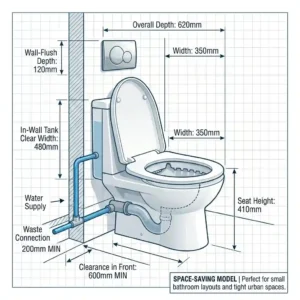
Here is where the perfect product fails. I frequently get clients wanting to squeeze a standing toilet into a 20-square-foot main floor powder room to impress guests. I actively talk them out of it. Even the sleekest waterless models require a minimum of 21 inches of clearance in front of them to meet basic building codes, and placing one directly next to a vanity creates severe ergonomic cramping. In tight spaces, a standard dual-flush toilet is always the smarter, more comfortable choice.
The First 30 Days: Setup, Usage, and Maintenance Cycle
Buying the fixture is only 10% of the journey. What happens after the plumber leaves? If you want your standing toilet to remain pristine and odor-free, the first thirty days dictate its lifespan.
The Waterless Maintenance Reality
If you purchased a waterless system, your first month requires retraining your cleaning habits. The biggest mistake you can make is treating it like a standard porcelain bowl. You cannot use bleach, abrasive powders, or heavy acid cleaners.
-
Daily Maintenance: Use a specialized enzyme-based spray mist. You simply spritz the bowl and walk away. The enzymes break down uric acid on the surface without disturbing the liquid sealant deep in the trap.
-
The 30-Day Check: Inspect the cartridge indicator. Depending on the model, there is a visual cue when the sealant is failing. In a standard two-person home, you won’t need a replacement for months, but checking it early ensures you don’t experience unexpected sewer gas leakage.
Splash Mitigation and Wall Care
Regardless of the model, microscopic splash-back is a reality of fluid dynamics. During your first few weeks, observe the wall and floor surrounding the fixture. I highly recommend installing an epoxy-based grout on the floor tiles beneath the unit and utilizing an eggshell or semi-gloss paint on the surrounding walls. Matte paint will absorb rogue moisture and eventually harbor bacteria, leading to a lingering “public restroom” smell that ruins the luxury feel of a residential install.
Standing Toilet vs. Traditional Commode: The Efficiency Gap
Why spend $500 adding an extra fixture when the standard toilet already does both jobs? The answer lies in calculating the Total Cost of Ownership (TCO) and the concept of the “Efficiency Gap.”
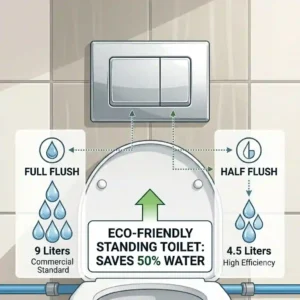
When you use a standard toilet for liquid waste, you are utilizing an incredibly overpowered tool for a simple job. A modern, high-efficiency traditional toilet uses 1.28 gallons per flush. A sensor-operated standing toilet uses 0.125 gallons. That means for every one flush of a traditional toilet, you could flush the standing fixture ten times. Over the course of a year, the water and sewage utility savings in areas with tiered water pricing (like California or Arizona) are staggering.
Furthermore, there is a mechanical wear-and-tear aspect. Traditional toilets rely on rubber flappers, fill valves, and wax rings. The more you use them, the faster they degrade. By diverting 70% of the daily bathroom traffic to a standing toilet with no moving tank parts, you effectively triple the lifespan of your primary commode’s internal hardware.

How to Choose a Standing Toilet for Residential Use
Navigating commercial plumbing specs for a residential build is confusing. Here is my exact consulting framework for choosing the right unit:
-
Assess Your Wall Depth: Traditional residential walls are built with 2×4 studs. Many premium standing fixtures require specialized in-wall carrier systems that house the plumbing and support the weight of the ceramic. These often require a 2×6 plumbing wall. If you only have a 2×4 wall, you must filter your search to “wall-hung, top-spud” models that don’t require heavy in-wall infrastructure.
-
Determine the Water Source: Do you have easy access to a water supply line above the drain? If not, ripping open the drywall to run copper pipe will triple your installation cost. In this scenario, a waterless model is the most economically viable choice, as it only requires connection to the drain line.
-
Analyze the Drain Height: Standard toilets drain through the floor. A standing toilet drains through the wall. Your plumber must verify that your main stack has the proper slope and venting capacity to accept a wall-bound waste line at the correct height (usually 17 to 24 inches off the finished floor).
-
Evaluate Odor Tolerance: If you are highly sensitive to smells, stick to flushed systems. While waterless systems are technically odorless when maintained perfectly, humans are prone to error. A flushed system guarantees the P-trap is replenished with clean water every single time.
Hidden Costs and Long-Term Maintenance Planning
Never buy a plumbing fixture based solely on the upfront retail price. You must calculate the “Year One” roadmap.
If you opt for a traditional flushometer model, the hidden cost is the water pressure requirement. Standard home water pressure is around 50-60 PSI. Commercial flush valves often require a minimum of 25 GPM (Gallons Per Minute) flow rate to operate the diaphragm correctly. Upgrading your home’s water supply lines from 1/2-inch to 3/4-inch to accommodate this flow can cost thousands in plumbing labor.
Conversely, the hidden cost of waterless systems lies in consumables. The proprietary sealing liquid and replacement cartridges run about $30 to $50 per swap. If you have to replace them three times a year, you are adding $150 in annual operating costs. You have to weigh that $150 against your local water utility rates. In a place where water is cheap, a waterless unit actually costs more to operate annually than a 0.125 GPF flushed unit.
Common Installation Mistakes to Avoid
In my decade of roughing in plumbing, I’ve seen some catastrophic DIY failures. Here are the pitfalls to avoid:
-
Ignoring the Blocking: You cannot screw a 50-pound ceramic bowl into half-inch drywall and expect it to hold. You must install solid wood blocking (usually a 2×8 or 2×10) horizontally between the studs during the rough-in phase to anchor the mounting brackets.
-
Improper P-Trap Alignment: The drain coming out of the wall must perfectly align with the fixture’s internal trap. Being off by even a quarter-inch will compromise the gasket seal, leading to slow leaks inside the wall cavity that you won’t notice until the drywall starts rotting.
-
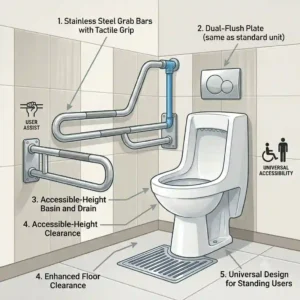
Forgetting ADA Compliance Guidelines: Even in a private home, it’s wise to follow the Americans with Disabilities Act (ADA) height recommendations if you plan to age in place or sell the home. Mounting the rim exactly 17 inches from the finished floor provides the most universally comfortable and accessible height.
✨ Don’t Miss These Exclusive Deals!
🔍 Ready to finalize your bathroom blueprint? Click on any highlighted product above to secure the exact model that fits your design vision, and transform your daily routine with superior water efficiency!
Conclusion and Final Verdict
Adding a standing toilet to your residential property is no longer a fringe architectural choice; in 2026, it is a smart, eco-conscious investment that elevates the functionality of your home. Whether you opt for the striking, zero-water efficiency of the Kohler Steward or the heavy-duty, commercial reliability of the Sloan Washbrook, the key to success lies in matching the fixture to your home’s infrastructure and your personal maintenance habits.
Remember, the spec sheet only tells half the story. Pay attention to your wall depth, understand the water pressure demands of flush valves, and don’t underestimate the importance of proper in-wall blocking. By following the field-tested advice in this guide, you can bypass the common installation headaches and enjoy a cleaner, more efficient bathroom for decades to come.
FAQs
❓ What is the point of a standing toilet in a home?
✅ It drastically reduces water consumption, improves overall bathroom hygiene by preventing seat-splatter on standard commodes, and speeds up bathroom efficiency in busy or large households. It is especially popular in modern master suites and finished basements…
❓ Do standing toilets smell bad over time?
✅ No, not if maintained properly. Flushed models act just like standard toilets. Waterless models use a chemical or oil-based sealant barrier in the trap that completely blocks sewer gases. Odors only occur if this barrier is neglected or incorrectly cleaned…
❓ Can a standing toilet be installed anywhere?
✅ No. It requires a dedicated wall drain and a properly vented plumbing stack. Unlike standard toilets that drain into the floor, these fixtures require behind-the-wall plumbing modifications, making them best suited for new construction or down-to-the-studs remodels…
❓ How much water does a standing toilet actually save?
✅ A standard toilet uses 1.28 to 1.6 gallons per flush. High-efficiency standing units use 0.125 gallons or zero water. In a home with three males, replacing standard flushes can save between 3,000 and 5,000 gallons of water annually…
❓ Are waterless standing toilets hygienic?
✅ Yes. Because the surface remains dry, bacteria have a much harder time multiplying compared to a constantly wet porcelain bowl. Furthermore, because there is no flush plume (the aerosolized spray created by flushing), airborne bacteria are virtually eliminated…
Recommended for You
- 5 Best Automatic Toilet Lid Closer Models for Hygiene (2026 Reviews)
- 5 Best toto one piece Toilets for 2026: An Expert’s Ultimate Guide
- 5 Best black toilet with bidet Combos Unveiled (2026)
Disclaimer: This article contains affiliate links. As an Amazon Associate, I earn from qualifying purchases. If you purchase products through these links, we may earn a small commission at no additional cost to you.
✨ Found this helpful? Share it with your friends! 💬🤗
[addtoany]
