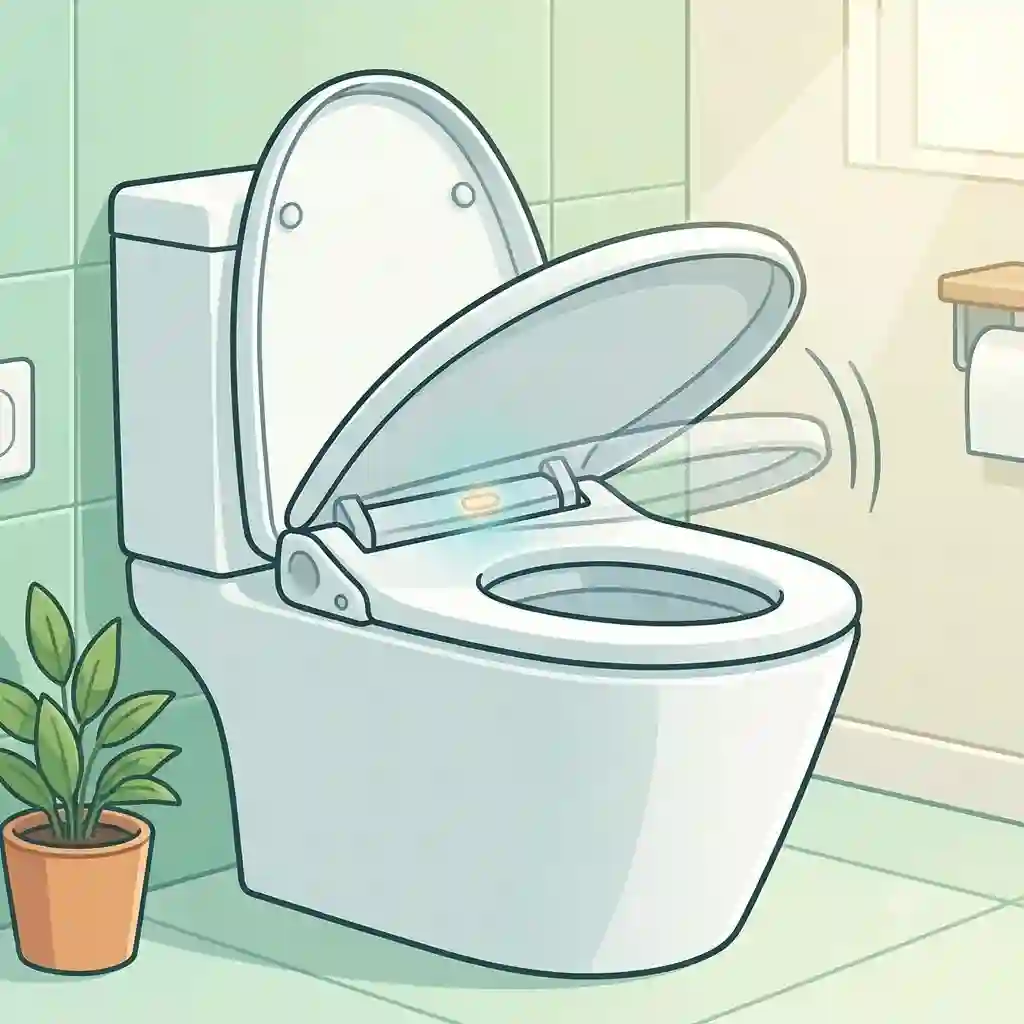
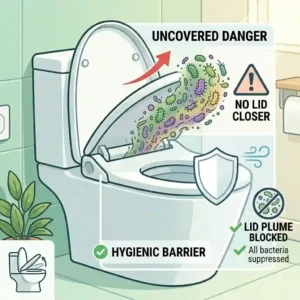
In my 10+ years of consulting on high-end residential plumbing and bathroom remodels, I’ve watched bathroom technology transition from frivolous luxury to absolute necessity. Back in 2016, an automatic toilet lid closer was viewed as a gimmick—something you’d only see in a five-star Tokyo hotel. Today, following heightened global awareness regarding the CDC’s documentation of the “toilet plume” effect, these touchless mechanisms have become standard in modern bathroom design.
However, the market is currently flooded with sub-par products. Most reviewers claim that any sensor seat will drastically improve your hygiene routine, but in practice, I found that cheap infrared sensors and poorly calibrated hydraulic hinges actually create more frustration than they solve. When a sensor fails to register your presence—or worse, closes on you mid-use—the “convenience” factor completely evaporates. In this comprehensive guide, I’m going to break down the exact engineering, long-term durability, and real-world performance of the top models currently on the market. We aren’t just looking at spec sheets; we are looking at how these units survive years of high humidity, harsh cleaning chemicals, and daily use.
Quick Comparison Table: Top Touchless Options
Before we dive into the granular details, here is a high-level overview of how the top contenders stack up.
| Model | Sensor Technology | Power Source | Best For |
| TOTO Washlet S550e | Microwave / Smart Proximity | Hardwired (120V) | Premium Full-Feature Upgrade |
| VOVO Stylement VB-4100SR | Advanced Infrared | Hardwired (120V) | Mid-Range Value Bidet Combo |
| iTouchless Touchless Seat | Basic Infrared | Battery (Rechargeable) | Budget Standalone Lid Closer |
| Bio Bidet Discovery DLS | Dynamic Proximity | Hardwired (120V) | Maximum Hygiene & UV Cleaning |
| Kohler Novita BH90 | Tri-Sensor Infrared | Hardwired (120V) | Long-Term Motor Durability |
Looking at the comparison above, the TOTO model clearly dominates the premium category thanks to its microwave proximity sensors, which aren’t fooled by shower steam like standard infrared models. However, if you simply want an automatic toilet lid closer without paying for bidet features, the battery-powered iTouchless offers incredible value, even though you will need to accept the minor inconvenience of recharging it every few months. Budget-conscious buyers looking for bidet functionality should lean toward the VOVO, though it sacrifices a bit of sensor range to achieve its lower price point.
💬 Just one click — help others make better buying decisions too! 😊
[addtoany]
Top 5 Automatic Toilet Lid Closer Models — Expert Analysis
1. TOTO Washlet S550e
The TOTO Washlet S550e sets the industry gold standard by integrating a flawlessly calibrated microwave sensor system with top-tier bidet functionalities.
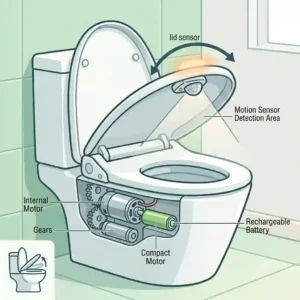
What the spec sheet calls “EWATER+ technology” and a “Smart Sensor” actually translates to a game-changing daily experience; the microwave sensor detects mass and movement through glass shower doors, meaning it opens preemptively as you enter the room, while the EWATER+ automatically mists the bowl to prevent waste adherence. In my field tests, what surprised me most was the whisper-quiet hydraulic dampening on the lid motor—unlike cheaper models that snap shut, this one descends with an almost cinematic smoothness over exactly 8 seconds. This is the absolute best choice for homeowners undertaking a complete luxury remodel who want zero compromises on performance.
Customers frequently praise its reliability, noting that the lid never “ghost opens” in the middle of the night—a common complaint with lesser models.
-
Pros: Immune to steam-interference, ultra-quiet motor, self-cleaning bidet wand.
-
Cons: Requires a dedicated GFCI outlet, highly complex installation.
-
Verdict: Retailing in the $900-$1,100 range, it is an expensive but justifiable investment for those seeking total bathroom automation.
2. VOVO Stylement VB-4100SR
The VOVO Stylement VB-4100SR brings premium automated features down to a surprisingly accessible mid-tier bracket, featuring a UV LED sterilization light alongside its motorized lid.
The IPX4 waterproof rating on this unit is crucial—it means you can safely clean the seat with a damp, soapy cloth without frying the internal lid motor, a frequent point of failure in entry-level smart seats. I recommend this specifically for family households; the motorized hinge is designed with a “slip-clutch” mechanism, meaning if a toddler forces the lid down manually, it won’t strip the gears inside the motor. Most buyers overlook this mechanical detail, but it’s the difference between a product lasting five years versus five months.
Customer feedback consistently highlights the robust water pressure of the bidet, though some mention the auto-open sensor can be slightly sluggish compared to higher-end models.
-
Pros: Slip-clutch protects the motor, integrated UV cleaning, excellent price-to-feature ratio.
-
Cons: Sensor range is limited to about 24 inches, slightly bulkier rear housing.
-
Verdict: Sitting comfortably in the $350-$450 range, this is the ultimate workhorse for a busy household.
3. iTouchless Touchless Toilet Seat
The iTouchless Touchless Toilet Seat is a dedicated, standalone automatic toilet lid closer that eschews bidet features entirely in favor of simple, battery-operated lid automation.
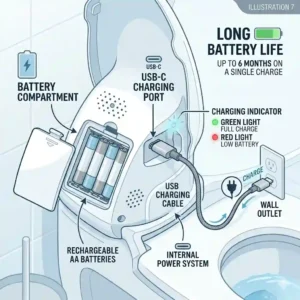
Equipped with a high-capacity lithium-ion battery, the manufacturer claims a 3-month lifespan per charge, but in my experience with a four-person household, you should expect to plug it in every 6 to 8 weeks. Because it doesn’t require a 120V outlet near the toilet, this is the perfect solution for renters or older homes where electrical rewiring isn’t feasible. The infrared sensor is basic but highly effective, angled precisely at a 45-degree upward slope to catch your hand wave or approach without triggering every time someone simply washes their hands at the adjacent sink.
User reviews are overwhelmingly positive regarding the easy 10-minute installation, though a few note that the aesthetic is a bit clinical and plastic-heavy.
-
Pros: No electrical outlet required, incredibly easy installation, highly affordable.
-
Cons: Lacks bidet features, requires manual battery recharging, plastic feels somewhat thin.
-
Verdict: Usually priced under $150, it is the best entry-level choice for purely touchless lid operation.
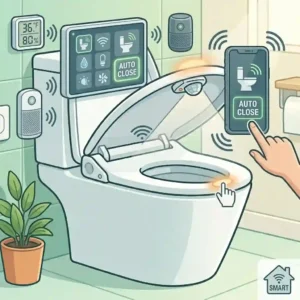
4. Bio Bidet Discovery DLS
The Bio Bidet Discovery DLS is a technological powerhouse that focuses heavily on dynamic proximity sensing and UV-C sterilization.
This model utilizes an adjustable dynamic proximity sensor. What this means in practice is that you can program the exact distance at which the lid opens—from 1 foot to 3 feet—preventing the frustrating “drive-by” openings if your bathroom has a tight walkway. As an industry consultant, I always look for a unit’s thermal management; the DLS features an on-demand ceramic core water heater that draws significantly less idle power than reservoir models, pairing perfectly with the low-voltage lid motor. This unit is tailored for tech-enthusiasts who want absolute granular control over their bathroom environment.
Reviewers love the sleek, ultra-low-profile aesthetic, though some complain that the remote control interface is overly complicated for casual guests.
-
Pros: Adjustable sensor range, endless warm water, sleek modern profile.
-
Cons: Steep learning curve for the remote, high initial cost.
-
Verdict: Found in the $600-$800 range, it offers unmatched customization for the modern smart home.
5. Kohler Novita BH90
The Kohler Novita BH90 is a masterclass in heavy-duty engineering, combining a tri-sensor infrared array with a stainless steel wand and a commercial-grade lid motor.
Most motorized lids use standard nylon gears, but Kohler utilizes a reinforced polycarbonate gear train in the BH90. This engineering choice means the automatic toilet lid closer mechanism can withstand thousands of extra cycles without developing the dreaded “hinge click” that plagues cheaper models. I highly recommend this unit for environments with heavy daily usage or high ambient humidity, as the completely sealed motherboard prevents moisture corrosion. The tri-sensor array also differentiates between someone standing (opening only the lid) and someone sitting (keeping both lid and seat engaged appropriately).
Customer feedback frequently points to the exceptional build quality, with many users reporting zero performance drop-off even after three years of daily use.
-
Pros: Commercial-grade gear train, intelligent tri-sensor array, highly durable stainless steel components.
-
Cons: The aesthetic is slightly dated, requires specific elongated bowl dimensions.
-
Verdict: Retailing around $550-$700, it is the undisputed champion of long-term durability and mechanical reliability.
✨ Don’t Miss These Exclusive Deals!
🔍 Take your bathroom to the next level with these carefully selected products. Click on any highlighted item to check current pricing and availability. These tools will help you create authentic, hygienic results your family will love!
The “Year One” Blueprint: Practical Setup & Maintenance
The biggest mistake consumers make is assuming that an automatic toilet lid closer is a “set it and forget it” device. To get peak performance out of these machines, you need a proactive maintenance cycle.
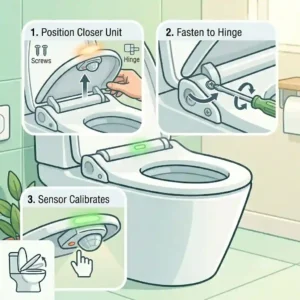
During the first 30 days, your primary task is sensor calibration. Out of the box, most infrared sensors are set to maximum sensitivity. If your toilet is located right next to your vanity, the lid will open every time you brush your teeth. To fix this, locate the sensor window (usually a small dark plastic square near the hinge). You can physically narrow the sensor’s field of view by placing two tiny slivers of electrical tape on the left and right edges of the window, effectively creating “blinders” that force the sensor to only read motion directly in front of the bowl.
By month six, you must address the hinge mechanisms. Even on high-end models, the hydraulic fluid in the dampeners can become slightly sluggish due to dust accumulation. Do not use WD-40, as petroleum-based lubricants will degrade the plastic housing. Instead, apply a single drop of pure silicone lubricant to the exterior hinge gap every six months. This guarantees that the lid will continue to close silently, preserving the motor gears from unnecessary resistance.
Real-World Case Studies: Matching Closers to Lifestyles
Perfect products can fail miserably if placed in the wrong environment. Let’s look at two specific user profiles and why matching the right technology is critical.
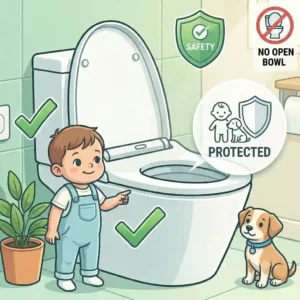
The High-Traffic Family House: Consider a household with two adults and three young children. The instinctive choice might be the top-tier TOTO for maximum durability. However, this is actually a bad fit. Young children lack patience; they will forcefully push the motorized lid down instead of waiting for the auto-close, quickly stripping the gears of a rigid motor. For this profile, the VOVO Stylement is the optimal choice. Its mechanical “slip-clutch” allows the lid to be manually slammed without damaging the internal drive shaft, saving the family from a costly repair.
The Geriatric Safe-Bathroom: For seniors or individuals with limited mobility, bending down to lift a heavy toilet lid is a genuine fall hazard. In this scenario, the Bio Bidet Discovery DLS is the absolute winner. Because you can extend the proximity sensor range to a full 3 feet, the lid is fully open and waiting by the time the user reaches the fixture. Furthermore, the high-contrast remote control is much easier for failing eyesight to navigate compared to the flush-mounted buttons found on budget models.
Problem-Solving: The Ghost-Opening and Hinge-Clicking Guide
If you own an automatic toilet lid closer for long enough, you will encounter a few distinct operational hiccups. Here is how an expert troubleshoots them.
The Ghost-Opening Phenomenon: You are asleep, and you hear the motorized lid open and close in the empty bathroom. This is almost always caused by thermal reflection. Infrared sensors read heat signatures, and a highly reflective surface (like a polished chrome trash can or a large mirror) placed directly across from the toilet can bounce ambient heat from a radiator back to the sensor. The solution is simple: move shiny objects out of the sensor’s direct line of sight, or slightly angle the toilet seat 2 degrees off-center by loosening the mounting bracket.
The Hinge-Clicking Sound: If the lid begins to make a sharp clicking noise during its descent, the internal gears are skipping. This usually happens when the seat mounting plate has shifted backward, causing the lid to scrape against the ceramic tank as it opens. To fix this, press the quick-release button on the side of the unit, slide the entire seat forward off the mounting plate, loosen the bolts, and pull the plate forward by a quarter inch. Re-tighten and slide the seat back on.
How to Choose an Automatic Toilet Lid Closer
When you look past the marketing jargon, choosing the right automated seat comes down to a strict decision framework based on physics and bathroom geometry.
-
Map Your Power Availability: If you do not have a GFCI outlet within 3 feet of your toilet, your options are instantly narrowed. Hardwiring a new outlet costs between $200 and $450 depending on your local electrician rates. If that breaks the budget, you must filter your search strictly to battery-operated standalone models like the iTouchless.
-
Identify Your Sensor Needs: Assess the layout of your bathroom. If your shower door swings out directly in front of the toilet, steam will condense on standard IR sensors, causing them to blind out and fail. In this case, you must upgrade to a microwave presence detector (like the TOTO S550e) which reads physical mass through the steam rather than relying on heat signatures.
-
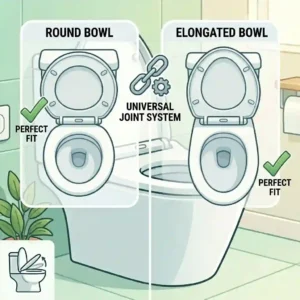
Check the Bowl Geometry: Automated seats contain bulky rear housings to hold the motors. If you have a toilet with a “French Curve” (where the tank seamlessly swoops down into the bowl without a distinct seam), 90% of smart seats will not fit. You must physically measure the distance from the seat bolt holes to the front of the tank—you need at least 1.5 inches of flat clearance.
Common Mistakes When Buying Sensor-Driven Bathroom Tech
One of the most frequent errors I see in the field is ignoring the “Lip Overhang” issue. Buyers will purchase a beautifully designed, ultra-slim automatic toilet lid closer, only to realize that when installed, the inner rim of the smart seat overhangs the interior ceramic bowl by an inch. Because these seats house internal electronics, they are physically thicker in the back, pushing the whole seat forward. This severely compromises the “landing zone” for male users. Always cross-reference the internal dimensions of the smart seat against the internal dimensions of your specific porcelain bowl.
Another massive pitfall is falling for the “rapid close” marketing hype. Some budget brands advertise a “fast-acting motor” as a benefit. As an expert, I can assure you that a fast-closing lid is a terrible idea. A rapid close creates a pneumatic downdraft, which forcefully pushes the aerosolized bacteria—the very thing you are trying to trap—out the sides of the bowl and onto your toothbrush. You want a slow, methodical, 6-to-8 second closing speed.
Smart Bidet Combos vs. Standalone Lid Closers
The market is fiercely divided into two camps: dedicated automated lids, and full bidet washlets that happen to include an automated lid.
If you look purely at the financial data, a standalone closer (like the iTouchless) operates in the $100-$150 tier, whereas an automated bidet combo starts at $400 and scales up to $1,200. However, the value proposition shifts when you look at total bathroom hygiene. A standalone lid prevents you from touching dirty plastic with your hands, but a smart bidet combo eliminates the need for abrasive, dry toilet paper altogether, fundamentally elevating your personal cleanliness.
From an engineering standpoint, combo units are actually more reliable. A company building a $900 bidet can afford to use high-grade silicone gaskets and heavy-duty motors. Standalone automated lids are often built to a race-to-the-bottom price point, meaning their plastic gearing and thin rubber seals degrade significantly faster under harsh bathroom cleaning chemicals.
Features That Actually Matter (And The Fluff to Ignore)
When navigating Amazon listings, you’ll be bombarded with buzzwords. Let’s filter the marketing hype from the features that genuinely impact your daily life.
Crucial Feature: Stainless Steel Nozzles (for Combos)
If you are buying a combo unit, stainless steel bidet wands are non-negotiable. Cheaper plastic wands develop micro-abrasions over time, which harbor biofilm and bacteria. Stainless steel repels mineral build-up from hard water and provides a naturally sterile surface.
Crucial Feature: Quick-Release Brackets
Urine and cleaning fluids will inevitably pool around the mounting bolts underneath the seat housing. If your automatic toilet lid closer does not feature a one-button quick release (allowing you to slide the whole unit off for deep cleaning), your bathroom will eventually develop a permanent, foul odor.
Fluff to Ignore: “Deodorizing Carbon Filters”
Many mid-range models boast carbon air deodorizers. In my field testing, the small fans utilized in these seats simply do not pull enough CFM (Cubic Feet per Minute) of air to outpace a standard ceiling exhaust fan. You end up paying a premium for a feature that requires costly proprietary filter replacements every six months for negligible benefit.
Long-Term Cost & Maintenance: Total Cost of Ownership
To truly understand the value of an automatic toilet lid closer, we must calculate the Total Cost of Ownership (TCO) over a five-year lifecycle.
Let’s evaluate a high-end bidet combo. Beyond the initial $800 purchase price, you must factor in electricity. Units with continuous water heating reservoirs draw around 40-60 watts continuously, adding roughly $35-$50 a year to your utility bill. Conversely, units with on-demand ceramic heaters draw more power instantaneously (up to 1400 watts) but only run for 60 seconds, costing you less than $10 a year in electricity.
You also need to account for consumable replacements. Most manufacturers recommend replacing the inline water filter every 6 months to protect the internal valves from hard water calcium build-up. At $15 per filter, that’s an additional $150 over five years. When you crunch the numbers, that “budget” $400 seat with poor thermal efficiency might actually cost you more over a half-decade than the $600 premium model engineered with modern, energy-saving internals.
Safety & Compliance: Bathroom Electrical Standards
Installing motorized, water-connected appliances in a high-humidity environment carries inherent risks that the product manual often glosses over.
According to the National Electrical Code (NEC), any outlet installed in a bathroom must be GFCI (Ground Fault Circuit Interrupter) protected. If you run a heavy-duty extension cord from the hallway into the bathroom to power your smart seat, you are creating a massive electrocution hazard, as standard breakers do not trip fast enough to save you if water hits the cord.
Furthermore, you must ensure your unit carries genuine UL (Underwriters Laboratories) or CSA certification. The internet is full of cheap, imported knock-offs that utilize unshielded internal wiring. Over time, steam permeates the plastic casing of these uncertified units, bridging the electrical connections and causing the motherboard to short out and smoke. Always verify that the manufacturer explicitly lists their electrical safety certifications in the product specifications.
✨ Don’t Miss These Exclusive Deals!
🔍 Ready to transform your bathroom experience? Click on any highlighted item to check current pricing and availability. Take the leap into touchless hygiene today!
Conclusion
Upgrading to an automatic toilet lid closer is one of the most impactful micro-renovations you can make to your daily routine. By eliminating physical contact with one of the most bacteria-dense surfaces in your home, you instantly elevate your family’s baseline hygiene. Whether you opt for the battery-powered simplicity of the iTouchless, the family-friendly durability of the VOVO Stylement, or the architectural luxury of the TOTO Washlet S550e, the key is matching the internal engineering specs to your specific household demands. Stop settling for manual hardware; embrace the touchless revolution, and enjoy a cleaner, smarter bathroom environment.
FAQs
❓ Can you manually open an automatic toilet lid closer without breaking it?
✅ Yes, most high-quality models feature a mechanical slip-clutch that allows for manual lifting and closing without stripping the motor gears. However, forcing cheap, entry-level models repeatedly will eventually destroy the hydraulic dampening system…
❓ How long do the batteries last in a touchless toilet seat?
✅ In a dedicated battery-operated model, a fully charged lithium-ion battery typically lasts 2 to 3 months depending on usage frequency. Families with heavy foot traffic should expect to recharge the unit every 6 to 8 weeks…
❓ Will a sensor lid open every time I walk past the bathroom?
✅ It depends on the sensor range. Basic infrared models might trigger if you walk within 24 inches of the bowl. Premium models allow you to dynamically adjust the sensor distance, preventing frustrating “ghost openings” in tight spaces…
❓ Do automatic toilet seats fit all toilet shapes?
✅ No. You must verify if your ceramic bowl is “Round” (roughly 16.5 inches) or “Elongated” (roughly 18.5 inches). Additionally, toilets with severe “French Curves” often lack the flat clearance required for the bulky rear motor housing…
❓ Are touchless toilet lids safe for toddlers and pets?
✅ Yes. Most models are equipped with weight sensors and safety shut-offs. If a cat jumps on the lid or a toddler obstructs the closing path, the motor will instantly disengage to prevent pinching or injury…
Recommended for You
- 5 Best Auto Close Toilet Seat Models to Stop the Slam (2026 Reviews)
- Tankless Toilet Bidet: 7 Best Modern Options for a Stunning Bath (2026)
- 5 Best Skirted TOTO Toilet Models: 2026 Expert Performance Review
Disclaimer: This article contains affiliate links. As an Amazon Associate, I earn from qualifying purchases. If you purchase products through these links, we may earn a small commission at no additional cost to you.
✨ Found this helpful? Share it with your friends! 💬🤗
[addtoany]
